Central London: Area of St. Paul's (Wed.)
This was our only day spent in central London. In addition to the walk around St. Paul's, we visited Stanford's Bookstore and the Harp Pub, two favourite places. One could not ask for a better way to spend a day! The City pub visits will be detailed in Part 4 of this write-up.
Today we were using Baedeker's "London and its Environs", from 1905. I bought the book several years ago at John King Books in Detroit, and have been an avid reader of it and its incomparable maps. We were curious as to what had changed (plenty) and what still remained (plenty). We began at the cathedral and strolled north and then west. To the north nearly everything had changed once we were near the Museum of London. The only good thing that came out of that ghastly area visit was the old London Wall, which has now been properly excavated and can be walked.
The Old Bailey building was just being constructed in 1905. Holborn Viaduct was still a modern marvel of engineering, and at least two churches had been bombed in WWII. Christchurch by Wren still had the tower and walls standing. Within the ruins was a tranquil garden with benches, where we ate our lunch. City Temple had been destroyed except for its tower, and rebuilt. Otherwise, much remained. It was a fun couple of hours, though the weather was ornery today. We got caught in two rain storms and a hail storm, and it was windy and cold. It was also sunny. One of those English days.

St Paul's Cathedral, the center of a very interesting area of London.

Patre Nostre Square is just north of the cathedral, and once housed small shops devoted to selling religious items, such as rosaries. It is now completely modernized, and quite ugly. However, this modern bust was really well done and attractive.

Strange bird artwork located in the
Pater Nostre Pub, a Youngs establishment.

Standing at the entrance to the bombed Wren Christchurch, which
is now an attractive garden and seating area inviting contemplation.
I think most churches should be open to the sky anyway (I call them
woodlands, and try to visit as often as possible).

We had to pay a pound to visit St. Bartolph's Without Aldgate. I think it was a pound well spent. The church lies within Postman's Park, where a tribute wall celebrates many individuals who gave their lives rescuing others from danger.

Part of the neighbourhood surrounding Postman's Park. London is a rather eclectic mix of architecture. A White Horse Pub used to occupy the building behind the tree.

Roman and medieval London are on display along the London Wall.

A keep, or guard tower (think of a rook in chess), along the London Wall.

More London wall, and also a view of St. Giles Cripplegate, final resting place of John Milton. The area around the church is an architectural disaster zone (Barbican center), and we could not find our way to the church. New fencing is an insult.

The Old Bailey (criminal court). This building was under construction when the 1905 Baedeker Guide was written.

A great pub sign, and a great pub! See Part 4 for inside photos.

Holborn Viaduct bridge over Farringdon Road. Instead of a nice red bus, I managed to catch a bin lorry crossing the bridge. It was raining by now, and we had to press on. The viaduct was built in 1869, and still works as well as ever!

We took shelter from the cold and the rain in St. Andrew's (1686, erected by Wren). It is a magnificent church, and we are glad we popped in (thank you rain!).
From here it was on to Stanford's (through rain and hail), to meet up with a former music student. I last saw Rachael when she graduated Gr. 8 from our school, after which she moved away. We maintained a loose contact over the years via e-mail and Facebook. As a music teacher I am privileged to have known some very talented and very nice people, and Rachael is certainly one of the more memorable ones. She joined every music activity I ever offered at our school, excelling at them of course, and was also my main assistant with the school website for two years.
Anyway, we got caught up over coffee at Stanford's, where I introduced her to the Capital Ring and the London Loop. She purchased the Ring guidebook and hopefully will soon embark on a wonderful journey. She currently works at a pub in Windsor, UK. She was just back from a two-week holiday that took her to Prague, Vienna, Berlin, and Naples.
Deb and I finished up our London day at the Harp, my favourite London pub. More details in the pub section!
Capital Ring Segment 5 (Thurs.)
Thursday was an uncomplicated day. Train from East Croydon to Streatham Common. Ring Segment 5 to Wimbledon Park. This was the final Ring segment needed to complete our south half, from Woolwich foot tunnel to Richmond (we had done the Richmond Park segment many years ago as our first foray into the Ring). However, today's 5-mile walk turned out to be more of a pub crawl, with no less than seven good pubs available on this segment. So, you will learn more about this walk by reading the pub section!

Leaving Streatham Common Station, this unique waterworks facility gives the impression of being in a much more exotic location than suburban London!

We have come 23 miles from our starting point, according to this sign. Highgate Wood here we come!

Refreshment stop at The Hope, one of many fine pubs along the walk. Deb has some delicious type of water. I was forced to drink ale!

There were some natural areas on this hike, but after so many pub stops it all becomes a bit blurry in my mind. I remember the pubs, though.
Upminster Windmill Search, and Leigh-On-Sea (Fri.)
Our travel cards allow us unlimited travel on London trains, tubes, buses, and trams for one week. If we are going outside of London, we try to get to the furthest station on our travel card before purchasing tickets to our final destination. Caroline, our London bestie, was curious about a windmill in Upminster, which was the farthest we could travel east towards the sea on our travel cards. So we journeyed in the morning to Upminster (Zone 6) and went searching for a windmill. Here is the Upminster village sign, clearly showing a windmill.

Upminster town sign. We saw the windmill,
the church, and the new interpretive center,
with not a thatched roof, but an even better living one.

The historic windmill is in ghastly condition. Thankfully, a full
restoration is underway. Someday the London Loop will take us
back here, when we hope to report that things are as they should be.

St Lawrence Church, Upminster (also displayed on the village sign!)
Caroline was not travelling with us to Leigh-On-Sea, so we parted at the Upminster Station (after a tea and coffee stop near the station). It was only 6 stops and about 20 minutes to our destination, but it seemed a world removed from busy London. We travelled on C2C electric service in comfort, and had a good glimpse of the ruined Hadleigh Castle as we approached the Leigh-On-Sea station. The town is not really on the sea, but near the very end of the Thames estuary. The sea can be viewed, however, and is only a short hop away.
From the station it is a pleasant 30 minute countryside walk to the hilltop castle ruins. We spent about 45 minutes at the castle before walking back to visit the town. We visited three riverfront pubs, a cafe, and a shop selling all manner of touristy things (Deb bought a small wooden ship model which will appear in one of her upcoming short films). Then we climbed Church Hill Lane to reach a bus stop which took us to the Oak Tree Veg restaurant, where we enjoyed a fabulous vegan meal and dessert before taking the bus back to the station. It took two hours to get back to our hotel in East Croydon from the restaurant, involving the bus, the C2C train, the Jubilee tube line, London Overground, and the Croydon tram service (right to the door of the hotel!).


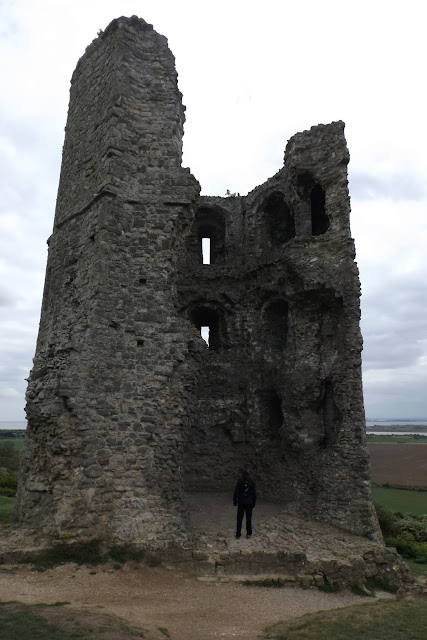


From the station it is a pleasant 30 minute countryside walk to the hilltop castle ruins. We spent about 45 minutes at the castle before walking back to visit the town. We visited three riverfront pubs, a cafe, and a shop selling all manner of touristy things (Deb bought a small wooden ship model which will appear in one of her upcoming short films). Then we climbed Church Hill Lane to reach a bus stop which took us to the Oak Tree Veg restaurant, where we enjoyed a fabulous vegan meal and dessert before taking the bus back to the station. It took two hours to get back to our hotel in East Croydon from the restaurant, involving the bus, the C2C train, the Jubilee tube line, London Overground, and the Croydon tram service (right to the door of the hotel!).

C2C lines at Upminster station, also the final stop on the eastern end of the District Line tube. Upminster is a hilltop town, as can be easily seen from the steep drop the tracks take after leaving.

Some of the ruins can be seen from the train approaching Leigh-On-Sea station.
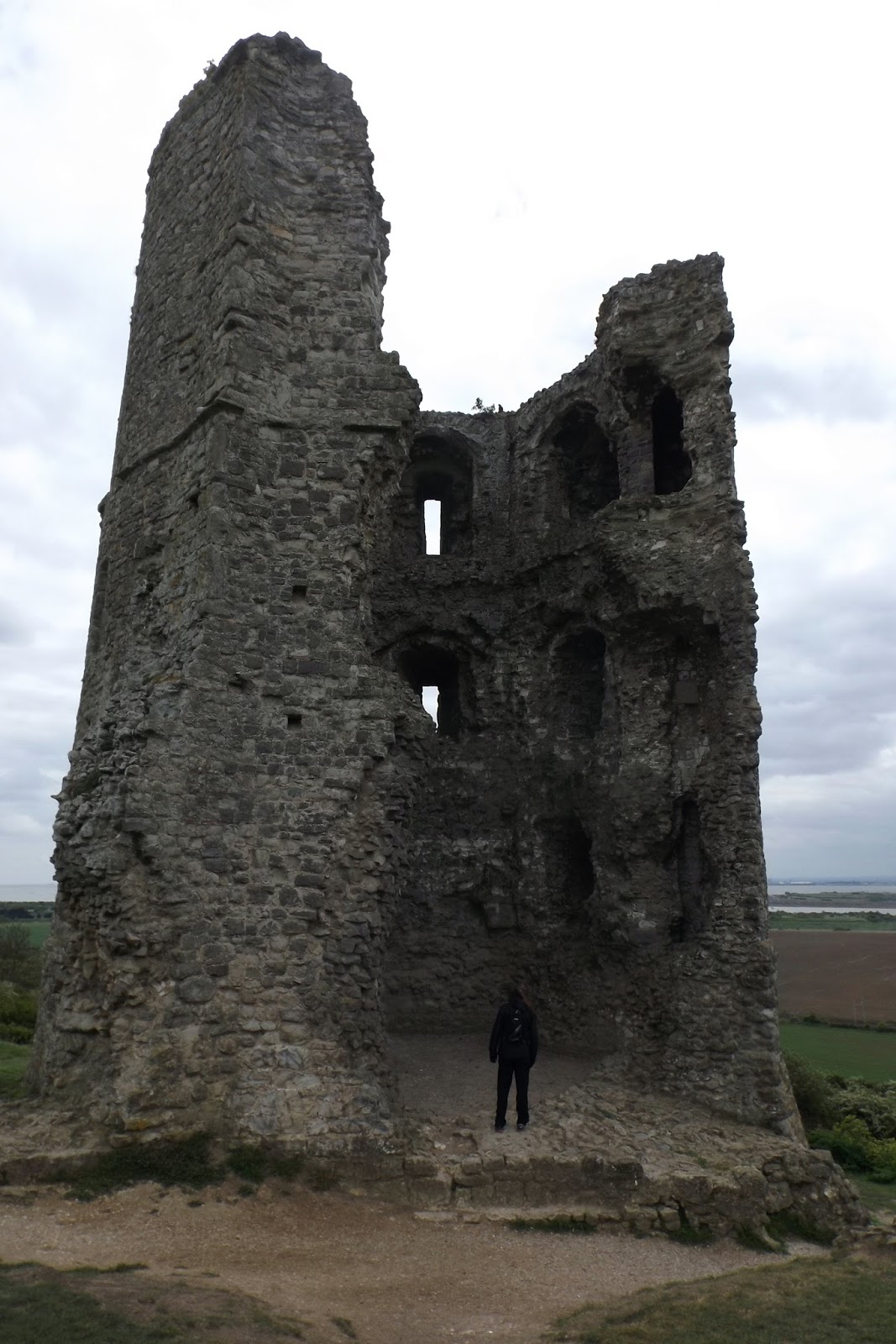
Deb contemplates the good old days at the southeast tower.

Artist's impression of the castle in full bloom. In the photo above the drawing, Deb is standing in the tower at left, top in the drawing (the smaller tower).

The sign indicates the many historic phases of the buildings.

Even just after it was built and still fairly new, there were problems with settling earth affecting the angle of things. View is towards the town and the Thames estuary.

The C2C service looks like a tiny model train. The line passes just beneath the castle and hill. View is east towards the sea, at the very end of the Thames River.

There was some impressive stonework at Hadleigh Castle.

Sailboats in harbour at Leigh-On-Sea.

Sara's Cafe and Tearoom, where we enjoyed coffee and a pleasant stop.

The old waterfront street is narrow and twists and turns past four
pubs, 2 cafes, and a few shops.

View east towards the sea from a footbridge over the tracks, at the east end of the waterfront area.

A handsome denizen of Church Hill Lane, Leigh-On-Sea.

Church Hill Lane, with a 2nd kitty on the prowl. River Thames in background.

At the top of Church Hill is...a church! This handsome tower
belongs to St. Clement's.
... to be continued in Part 3.