Friday, 27 October 2017

Vienna September 2017 Part Three: The City

Vienna:  The City  

We had six days to see the sights, and that included our two visits to the Kunsthistorische and one to the Albertina Museum.  That took up about a day and a half.  We also spent a day in the Vienna Woods and hills.  What time remained for exploring Vienna, then, was three and a half days.  However, we made the most of it, and knew our away around pretty well afterwards.  In total we managed four self-guided walking tours.  The Marco Polo Guide to Vienna was our main resource.  The three walk tours included in that book are called 1) Back to the Middle Ages:  Through the Heart of Vienna; 2) Coffee House Tour Around the Opera House and Hofburg; and 3) Kahlenberg and Leopoldsberg (The Vienna Woods).  We also took an older book with us entitled  Viennawalks.  We undertook Walk #3 from this volume, entitled Noble Vienna.  That last one took us two days to complete, and included no less than 27 palaces, as well as much other architecture, several churches, and public plazas.

The photos are mostly in chronological order, though I have blended all the walking tours together and will just use images rather than many words.  Some places we visited more than once (Hofburg, Ferstel Palace).  Enjoy!  If you wish to see a larger version of a photo, simply drop me a line.

Side street view of St Stephan's Cathedral.  For scale, note the small
two-storey house attached to the side of the church.  The tower
(not shown) is 450' high!!  We did not get inside due to crowds.

Speaking of side streets, Vienna has some beauties.
It's easy to lose the main tourist traffic.

 Side entrance to St. Ruprecht's.

 Craft beer was the specialty at Mel's, the largest such place in Austria (Austria still has a ways to go as far as craft beer is concerned, but this place was excellent).

 I could only find one actual craft brewery in central Vienna.  We had to sit upstairs, as the main floor was a smoking area!!??!  Vienna is supposed to rejoin the civilized world this January, 
banning smoking virtually everywhere.

 We visited many of the classic Viennese cafes, except for a few that were just too busy with tourists.  Cafe Sperl was fabulous!

Otto Wagner's Art Nouveau apartment building across the street from the Naschmarkt.

Strudel, espresso, and tea at Cafe Museum (it's a cafe near museums, not a museum itself).  The strudel was other-worldly in its goodness.

Evening comes early to the narrow streets.  Browsing shop windows became
an enjoyable pastime.

 Our adventure to the Vienna Woods began with the full ride on Tram 37, from the university
all the way up to Grinzing.

 The charming village of Grinzing, a major wine-producing area, includes this wonderful old tram station.  There was a good cafe across the street (behind me), and we stopped here outbound and inbound.

 We ended up walking over four miles from Grinzing, and climbing almost 800' (higher than the hill in background).

 View of Cafe To Go and on to Vienna, at the summit of our walk.


This was the only hazy day!  The rest were perfectly clear.  Anyway, this is a telephoto shot down to the Danube from Cafe to Go.  The river is about 1000' lower than the cafe.

Central Vienna looking back up towards the Vienna Woods.

 An amusing doorbell, from one of our walks.

 Schottenkirche.  The number of stunningly beautiful churches in Vienna caught us by surprise.

Kinsky Palace and its famous elegant stairway.  One of our walks 
included visits, mostly exterior, to 27 palaces.

 Maria am Gestade, not far from Mel's Craft Beer.  Built 1313-1414.

Ferstel Palace, now home to Cafe Central and a high class shopping arcade.

Inside the arcade, Ferstel Palace.

 We made some serious purchases at Xocolat, inside Ferstel Arcade.  Next door was a craft coffee shop, the only one we encountered in central Vienna.  What a great pairing of shops!  We enjoyed our visit.

 Ferstel Palace.

 One of 27 palaces on our Viennawalks #3.  This one is now an art gallery.

 Former palace (see above), now a gallery.

Entrance to the art gallery palace.  We didn't know what was upstairs.  We went in, went up, and just poked around (see two photos, above).

 Yet another palace.  Imagine Ball season in Vienna!  No wonder Strauss was so beloved.

 Minoritenkirche exterior detail.

Minoritenkirche Gothic walkway. 

Affectionately called the Chest of Drawers building.


Approaching St Michaelerplatz and Church, the tourist heart of Vienna.

 Demel Cafe, Vienna.  Terrible strudel, but pretty fine ambience.

 Caryatids, supporting much of Vienna for centuries.

This one manages to hold up a building and appear languorous at the same time!

Top half of Vienna's bizarre but very fine monument to the plague.  The 
Black Death hit Vienna in 1679 and took 15% of the population.

 Tea and wine, Vienna.  We often found a fabulous historic cafe that was not busy.

 Shop window, Vienna.

 Shop window, Vienna.

Interior of St. Michael's.

Saturday flea market, St. Michael's.  Best room for a flea market I ever saw!

 Michaelerplatz, at the entrance to the Hofburg Palace.

 Central courtyard of the Hofburg, showing three clocks.  Bottom to top:  sun dial; mechanical clock; lunar phase clock.  All three were working perfectly!!!

 The Hapsburg Eagle, soaring high over Europe for many centuries.

 Augustinerkirche.

 St. Charles' Church, next to the Vienna Museum.

It was sunny and mild the entire week, something we did not expect.
People short and tall were out enjoying the park and the fine weather.

Where there's coffee, there's Deb.  Coffee-bike, Vienna.

Two Views of Greenland from 40,000'


Greenland is always a stunning sight from the air, and we crossed a large chunk of it coming home.  It was very early autumn, and it all seemed other-worldly.  We loved the entire trip, except the layovers at Pearson Airport, Toronto.  Those we could do without.

This concludes the on-line trip journal for Vienna, Austria, from late September 2017.  Hope you enjoyed your stay.  Feel free to leave a comment.

(Be sure to visit the other two Vienna pages here, on Music and Art). 

Mapman Mike

Tuesday, 24 October 2017

Vienna September 2017 Part Two: Famous Musicians

Encountering Famous Musicians in Vienna 

Virtually every great German musician lived in Vienna for a time, as well as a few non-German ones.  We encountered past deeds and houses of Gluck, Mozart, Haydn, Beethoven, Schubert, Brahms, Mahler, J. Strauss, and even Chopin.  I'm sure there were others, too, as well as many more sights that could have been visited using this theme.  We did not visit any cemeteries, and only managed to visit one of Beethoven's some 40-odd residences.  We merely glanced at the possibilities that Vienna offers the musical pilgrim.  We attended no concerts, though people dressed as Mozart were continually trying to sell us tickets to some.

 Statue and monument to Mozart, Ringstrasse, not far from the opera house.

 Large Michael's House, Michaelplatz.  Haydn lived in one of the tiny garret rooms, relegated to 2nd class citizen when, as a boy, his voice broke.  He complained of snow getting inside in Winter, and the sun pouring in during the summer.

 The Esterhazys were Haydn's patron and employer, and they had a palace in the city.  Haydn would perform his marionette operas while in Vienna.  This is the actual wine cellar at the rear of the palace, with Esterhazy estate wine still served in this little place.  I had an incredible glass of white wine for $3.25 Canadian, or 2.1 Euros.  This is a wonderful and cozy little gem, and I hope to return.

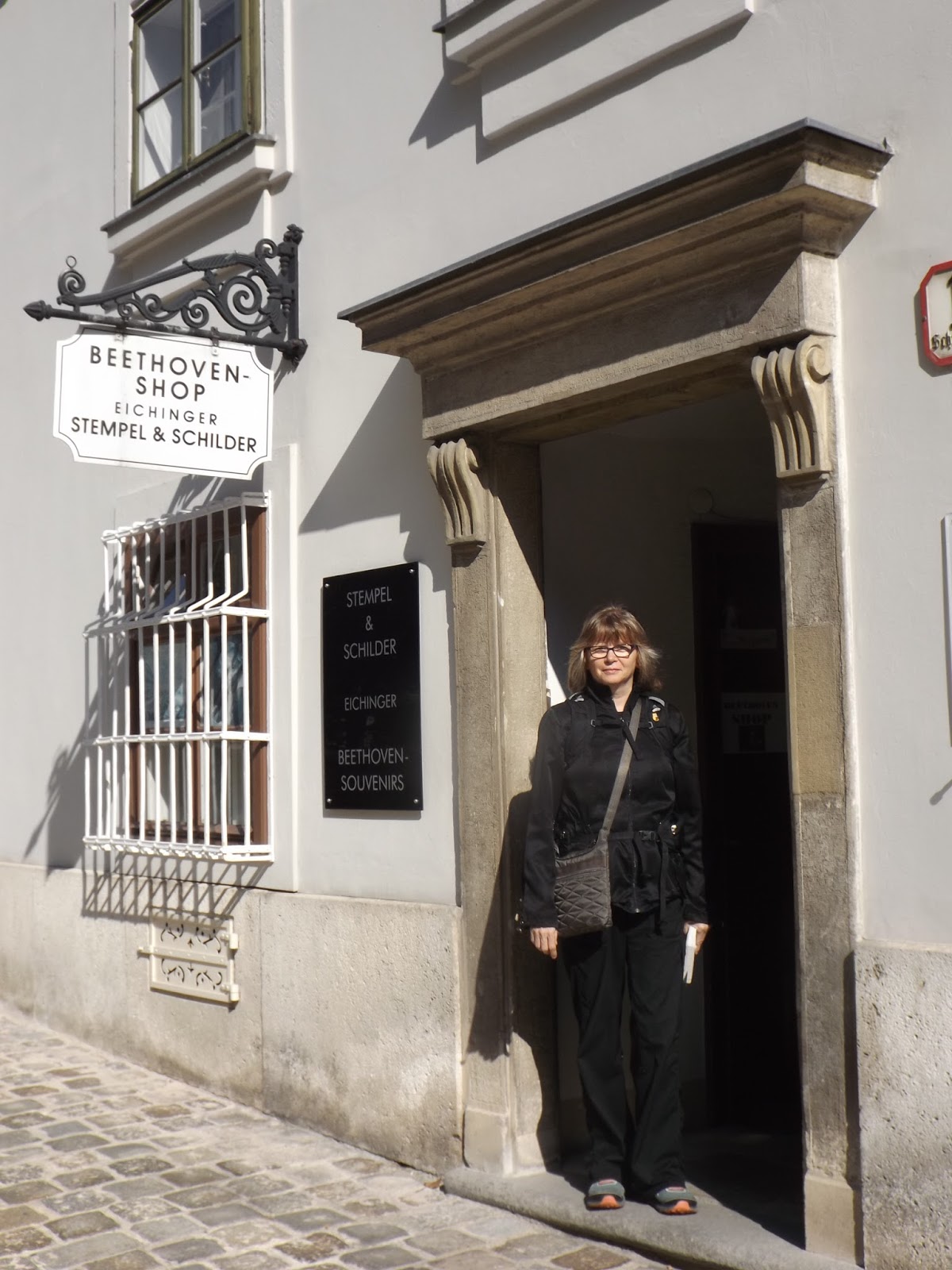
 Deb stands in the entrance to the Beethoven Shop (ground floor) and Beethoven Museum (way, way up stairs, four flights to be exact).  This is the Pasqualati House.

 None of Beethoven's pianos exist today (he likely beat them to a pulp), but this elegant model would have been current when the composer lived in this building.  Note the five pedals!

 Original version of one of the most famous paintings of Beethoven, from the early 1800s.
While living here the composer worked on Fidelio, his sole opera, as well as parts of the 7th and 8th Symphonies, and the 4th Piano Concerto.

Why do I feel so small and insignificant next to Brahms? 

Statue of Gluck we came across in our wanderings.

Chopin spent a winter in Vienna, in a house that once stood here.

 Once a palace, now one of the oldest sheet music stores in the world.  I bought a book of Schubert Impromptus.  I will learn the first one after my current concert program is concluded.

 There were more than a few non-musician tributes as well, even to philosophers.  Imagine a statue in Windsor dedicated to a philosopher.  Difficult, isn't it?  Note the stone relief at the center far right of the photo, so typical of little things seen while wandering the streets of Vienna.

Mapman Mike
Monday, 23 October 2017

Vienna, September 2017, Part One: The Paintings

After many years of wanting to visit this great European city, we finally took the plunge.  There were no discount airfares for us, but we got a fantastic hotel at a great price.  We flew from Windsor, Ontario via Air Canada and through Toronto, then on to Warsaw via LOT (Polish Airlines), and from Warsaw to Vienna via Austrian Airlines.  Going there and returning were epic days, though all flights went pretty well except the final one home back to Windsor.  We were gone 8 1/2 days, though only 6 of those were visiting Vienna; the rest were travel days.

Our main interest in visiting Vienna was to see paintings by Bruegel the Elder.  Vienna has 14 of them, though only 10 were on display during our visit.  This blog will be divided into three parts:  The Art; Encountering Great Musicians; and Vienna the City.  I hope you enjoy your visit here.  Feel free to leave comments.

Vienna Part 1:  The Art 

There are too many layers to seeing great art in Vienna.  It is a city so rich in history and artists and art collecting that even a large book would not do the topic justice.  So bear with me for this simple glance at what we managed to achieve in 6 days.  We spent a Monday through Saturday walking the streets and hills of Vienna, during the last week of September.  We hit perfect weather.  It was sunny every day, and mild.  We spent Tuesday and part of Thursday at the Kunsthistorisches.  Thursday morning we visited the Albertina.  On Thursday the Kunst is open late, and we took advantage.  It's expensive to get in, but no one blinked an eye when we purchased senior (65 and over) tickets.  It's nice to know that one always looks much older when travelling abroad!  Air travel will do that to a person.

Tuesday morning (the Kunst is closed Monday) we lined up about an hour after opening for our tickets.  Twenty minutes later we were inside one of the world's greatest art museums, checking our backpacks, studying a floor plan, and heading for Bruegel heaven!  It did not take long for the first kink in the plan to manifest itself.  Not only was the Bruegel room closed, but there were no paintings on the wall.  Several workers were scurrying about inside.  Once my heart began beating again, I noticed a small paper sign taped to the blockade.  "The Bruegel room will reopen at noon."  I glanced at my watch.  It was just after 11 am.  Time for a deep breath.  I can do this.

Deb and I toured the early Flemish galleries, and enjoyed watching a kindergarten class sitting beneath two ridiculous paintings by Arcimboldo.  We were off to a good start.  Then we began to notice other strange things.  The galleries seemed to have been hurriedly rearranged.  Many paintings had no tags identifying them.  We soon discovered that many of the Dutch, German, and Flemish galleries were closed, and that most of the Rubens paintings were not on display.  However, the main masterpieces by Vermeer, Rembrandt, Durer, and others were still up.  We returned to the Bruegel room just before noon.  It was open!  However, at least three paintings were not hanging.  But there were ten others waiting to be viewed!!!

 2 views of the entrance staircase, Kunsthistorisches, Vienna

  2 views of the entrance staircase, Kunsthistoriches, Vienna

 One of three fabulous self-portraits by Rembrandt.

 Vermeer's incomparable Art of Painting

Two of my very favourite paintings:  Return of the Herd, left; and Hunters in the Snow 

The lady who was nearly finished her eight month project of copying a Bruegel painting proved to be a pretty interesting person to talk with about the artist.  This is her job, and she works by commission.  After this she will copy Tower of Babel, then return and do this one again.  Needless to say it was great fun comparing her work to Bruegel's.  Her skills were flawless!


 Detail of Hunters in the Snow, Bruegel

 The Peasant and the Bird-Nester; Peasant Wedding; Peasant Dance; The Gloomy Day; The Conversion of Saul.

Fight Between Carnival and Lent; Procession to Calvary; Tower of Babel.  Ten Bruegel paintings were on display on our visit to Vienna.

Tower of Babel, detail

Each Bruegel painting is like a musical symphony.  I needed to devote my entire attention to each painting.  No talking, no taking notes, it was too dark for good photography--just commune time with great paintings.  Of course it is his landscapes that bring us back to the Master time and again.  Hunters in the Snow is likely the finest landscape painting in existence.  Return of the Herd, Gloomy Day, and Tower of Babel cannot be far behind.  I spent a long time with each painting, including the noisy peasant ones, finding it difficult to absorb the content in one sitting.  What then next year?  While visiting the gift shop I got to talking with an employee, obviously an art student who knew the museum as well as anyone.  Next year there is to be a Bruegel painting exhibit here.  Whatever would one do if confronted with twenty or more of his paintings?  There is only one way to find out.  I will be back in Vienna next November, and Bruegel will once again be on the menu.

His paintings are so rare (outside of Vienna).  Four or five are in the USA (including Detroit, thank the heavens!).  There has NEVER been a Bruegel painting exhibit before.  Even in his time practically no one ever saw his paintings.  They were bought by collectors and hidden from public view for centuries.  Many of his extant paintings (there are barely 40 known) are still in private hands, and never exhibited.  Will some of these be in the show next year?  Hopefully.

The museum has very comfortable seating, and the floors are friendly to people standing.  We were able to sit and view the paintings, or get right up close to them when we wished.  Though busy, the gallery was tolerable, and not just because most people spoke foreign languages.  It was nice not to have to listen to inane comments and understand them.

 Of course Vienna is noted for its extravagant and historic cafes.  The finest one is inside the Kunsthistorisches Museum, under the dome.

Central area of the Kunsthistoriches, Vienna.  The cafe is up under the dome. 

We returned to the art museum on Thursday evening, touring the Italian galleries as well as the decorative arts wing.  Many of the Italian galleries were also closed for the upcoming Rubens painting exhibit (missed it by less than three weeks--damn!).  However, masterworks by Titian, Giorgione, and others kept us enraptured and at a loss for words.  The decorative arts wings was as spellbinding as the painting galleries.  We did not get to tour ancient art this time, but it is a priority for our visit next year.

A Titian beauty, Vienna.

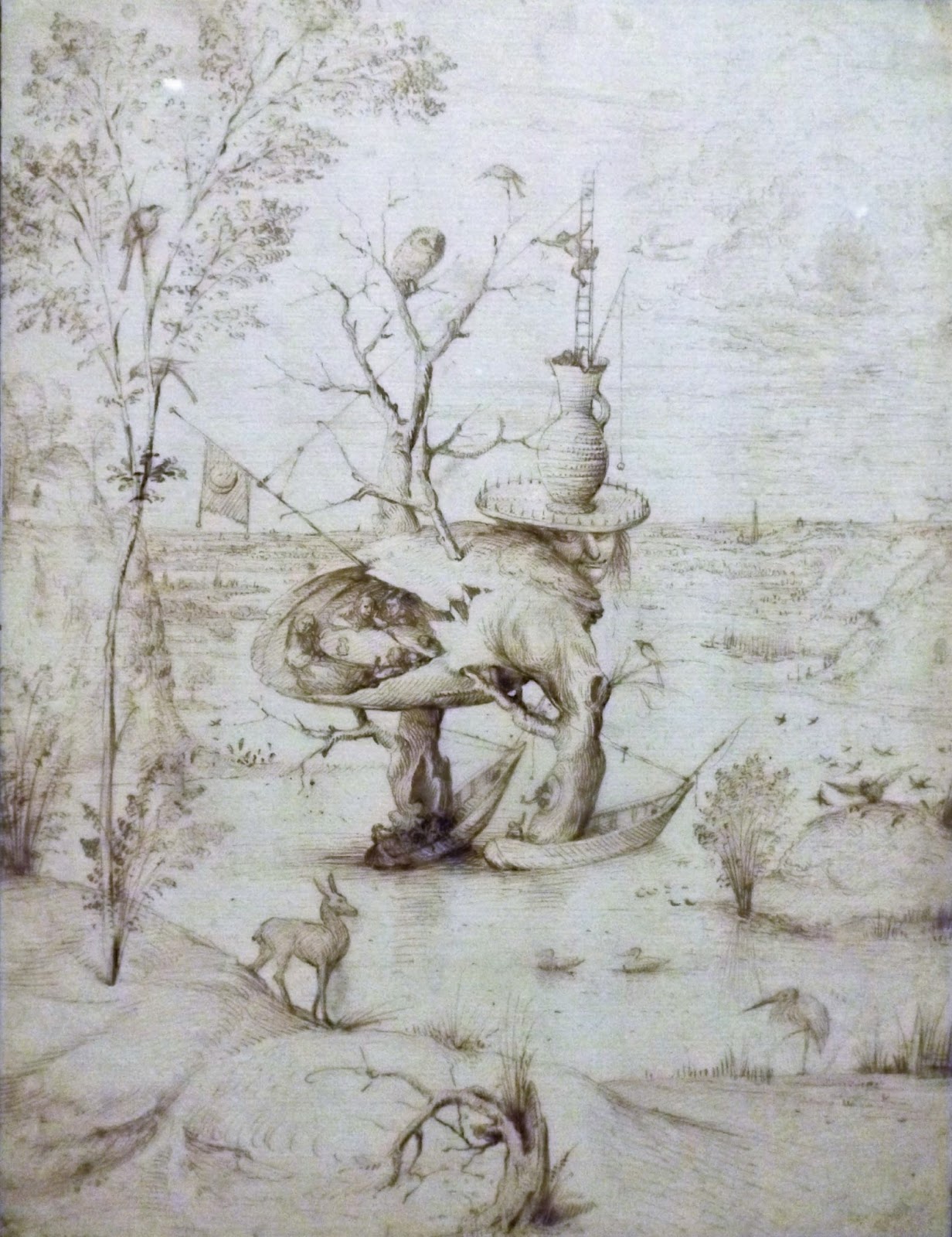
Thursday morning we visited the Albertina.  Originally it was not on our list.  However, the very helpful salesperson/art student at the Kunsthistorisches gift shop told us that the current Bruegel exhibit there was not to be missed.  I trusted her, and am glad I did!  I was expecting a showing of some of his prints and etchings.  They usually have some of his art on paper on display.  Would a wonderful shock to enter the exhibit (one of three at the Albertina on our visit) to see over 80 of his works on display, including twenty of his drawings!!!  We were in Bruegel heaven as we wandered room after room of his art, covering every aspect of his world, including his Bosch years.  One of Bosch's most famous drawings was also on display.  The exhibit was very busy, but as in the painting gallery, there was never an issue of having a private viewing for as long as one wished, and as often.
 Landscape, ink on paper, Bruegel the Elder

 Many people at the time thought that Bruegel outdid Bosch.  Can anyone argue against this?
 
 One of Bosch's most famous drawings was also on display in the exhibit.
 
The Artist and the Patron, one of the most powerful drawings on the subject, by Bruegel.

Even now, nearly one month later, my head is still pleasantly filled with images from Bruegel's art encountered in Vienna.  Had this been the sum of our experience there, then the trip would have been easily worth the expense and hassle of getting there.  But there was more.  Much more.
There were two other temporary exhibits at the Albertina on our visit.  One of them was entitled "Monet to Picasso," and the other one was "Raphael."  I was not in my right mind when I decided to do a quick walk-thru of the Monet exhibit instead of the Raphael.  I think I was mentally exhausted from the details in the Bruegel works, and wasn't ready to meet Raphael head-on.  Monet was easily digestible, on the other hand.  And we had paid another king's ransom to get into the museum, so we took a stroll into Monet.  The Albertina now owns a large collection of paintings, recently donated, and exhibits them in rotating shows.  There were Monets, there were Picassos, there were other Impressionists and Expressionists.  There were works by Klee, and a truly wonderful painting by Feininger, one of our favourite artists.  However, we walked unknowingly into a room of paintings by an Austrian 20th C. painter we had never heard of, and we would never be the same again.

Franz Sedlacek is one of the most amazing discoveries we have ever made, equal to the time we discovered a private collection of superb works by Dali in Cleveland, Ohio, many years ago.  Though well-known and loved in Austria, he is virtually unknown outside the country.  We gaped in disbelief at about ten of his paintings on display, not knowing if we were dreaming or actually seeing these things.  Later in the week we tracked down an exhibition catalogue of his art, purchased it, and it is now one of our most prized books!  Prepare yourself!

One of the really neat things about Sedlacek is that he was heavily influenced by early Flemish painting, including Bruegel.  This aspect tied in so well with our visit.

Winter Scene, Sedlacek

 The simply mind-blowing Twilight Song.  Let it be known that I would kill to own this painting.

 Landscape With Automobile, 1931.

We had a pretty fine time of it observing art in Vienna, without ever even getting to Klimt and his ilk.  Next time for sure.  One of the major painting museums was closed for renovations until November, so we will try to visit the Akadamie der Bildenden next time.  And to see more fantastic art by Sedlacek, put his name into Google Images, and enjoy the brain explosions.
 
Mapman Mike