Showing posts with label Hunters in the Snow. Show all posts

Friday, 28 December 2018

Vienna 2nd Visit, December 2018: Part 1 Kunsthistoriches and Bruegel

For the 2nd time in just over a year, we were drawn to Vienna to see art by Pieter Bruegel the Elder.  Considered one of the finest painters who ever lived, his incomparable landscape paintings, as well as his peasant works, draw people from all over the world to Vienna and the many other museums where his work is displayed, including Detroit.  The art museum in Vienna houses 14 of his paintings, and the Albertina, virtually across the street, houses many of his prints and drawings.  On our first visit in October of 2017, we went to see the Vienna Bruegel paintings.  11 of them were on display, which was plenty.  However, the Albertina was also home to a vast temporary exhibit of his prints and drawings, collected from museums worldwide.  So we had a double dose of the master!

This time, the Kunsthistoriches was hosting a major exhibit of his paintings and his prints and drawings.  30+ paintings and about 60 works on paper were being brought together in the largest exhibit of its kind, and likely the only one, ever.  We saw 3 of the Vienna paintings that were not on display on our previous visit, along with these works:  Mad Meg, from Brussels, and Triumph of Death, from Madrid, both recently cleaned and restored to pristine condition (all the Vienna paintings were also in pristine condition, with several restored especially for this exhibit!); from Rome came Bay of Naples; from Berlin came Two Monkeys (possibly my favourite painting of all time); from Rotterdam came the 2nd, smaller version of Tower of Babel, sitting alongside the larger Vienna version; from London came his mannerist Adoration of the Kings; from Prague came the magnificent Haymaking, shown with the three other extent Seasons paintings from Vienna, for the very first time; from Brussels came Winter Landscape with a Birdtrap, alongside one of the copies by his son Pieter the Younger; From Winterthur came Adoration of the Kings in the Snow, possibly the finest winter painting ever created; from Darmstadt came Landscape with the Magpie on the Gallows, considered by many to be his finest landscape; from the Louvre came The Cripples; from Munich came Head of an Old Peasant Woman, from England's Upton House, Banbury, came Death of the Virgin, and also a copy by Jan Brueghel the Elder of Massacre of the Innocents, alongside Vienna's original by Pieter the Elder; from the Frick collection in NYC came Three Soldiers; there was a recently rediscovered miniature painting called The Drunk Cast Into the Pigsty.  I may have missed one or two.  Don't forget about the Vienna paintings, including Hunters In the Snow and 14 others!  So it was a total extravaganza, and worth all the expense and effort to get to Vienna.  We went twice to the exhibit, and we barely scratched the surface.  I am currently reading the purchased catalogue and essays.  More essays will be published next autumn, the ones from the symposium (which was running on our visit, but was fully booked).

I will take you through a little photo journey of just one the paintings, Hunters In the Snow, courtesy of the Kunsthistoriches website called Inside Bruegel.....  If the photos do not all load first time, reload the page.
 Hunters In the Snow, Vienna.  Painted in 1565.  45"x64"

 Detail 1

 Detail 2

 Detail 3

 Detail 4

 Detail 5

 Detail 6
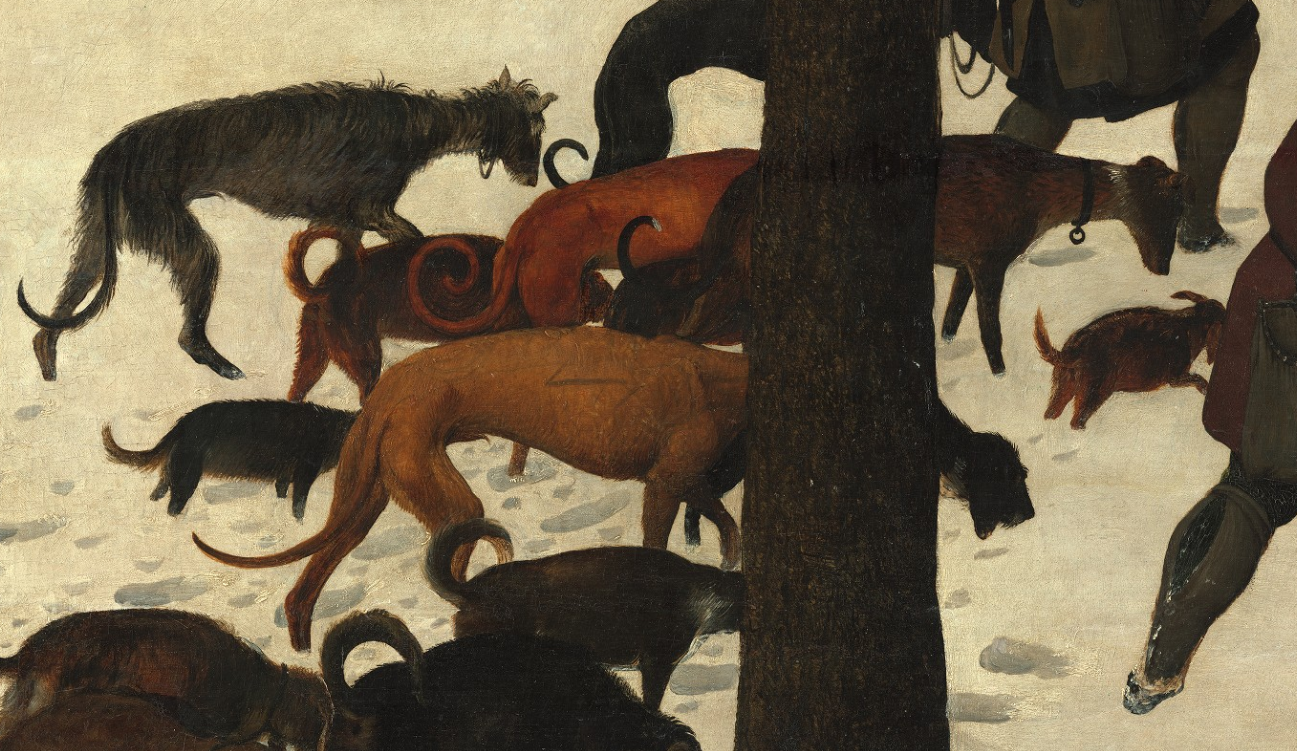
 Detail 7

 Detail 8

 Detail 9

 Detail 10.  That wee person in the bottom right is timeless.  I saw him skating in Detroit the other day.

 Detail 11--note the man shooting birds!

 Detail 12--the famous chimney fire, with water being thrown!

 Detail 13 

And on and on and on....  I hope you get the idea.  And this is only one painting.  All of his large works are like this, paintings within paintings within paintings.  Try to imagine 14 of these permanently within one museum, and then 30 of them in a temporary exhibit.  Sheer insanity!!  His works on paper are just as detailed.  At the start of the exhibit, while waiting for your ticket time to enter, they had three giant screens constantly showing 3 of his paintings in detail, with the "camera" constantly moving very slowly to different areas.  You were completely drawn into the artist's world before even entering the exhibit!

 Waiting room for the exhibit, with 3 large screens moving in slow motion across three different paintings.  It was spell binding, and the pictures were very high quality.

 Mad Meg, restored for the exhibit.  From Brussels.


The terrifying Triumph of Death, from Madrid, restored.

The incomparable miniature "Two Monkeys," from Berlin.  An entire room was devoted to this tiny picture, showing how it was created by the artist in stages.  It probably took him a day.

We also got to visit the archaeological wing of the museum, our first visit.  The collections are rich in Egyptian art and Roman art.  Their collection of Roman gold is totally unbelievable! 
 Deb and her Near Eastern hero.

Some heads.

Way more heads!

After our 2nd visit to the Bruegel exhibit, we separated for an hour within the museum.  Deb returned to the Wes Anderson curated exhibit, while I walked through Italian and French paintings.  Anderson and his partner got to choose anything from the storage vaults and come up with an exhibit.  The highlight was the title piece, "Spitzmaus Mummy in a Coffin and other Treasures."  Here are some of Deb's photos from that exhibit.

Wow!  Definitely a rare find.  Egyptian, 4 Cent. B.C.

 Madeleine, daughter of the Hirsute man.  German, c. 1580.


I am left somewhat without words for many of these objects....


Stage design model.

There were 411 objects, and they were exhibited in a cabinet of curiosities fashion.  It was a pretty engaging exhibit, and a rare chance to see objects that will seldom, if ever, be shown again.

Here are some final shots of permanent art from the Kunsthistoriches....

 A small Bosch.

3 Saxony Princesses, Cranach.  Too charming!

Deb in one of the galleries devoted to Rubens.

Detail of a painting with critters.

A Venetian beauty, by Titian.

Gallery and ceiling, Kunsthistoriches, Vienna.

We spent half a day Tuesday and half a day Thursday at the Kunsthistoriches Museum.  The rest of the time was spent re-exploring Vienna, which was all decked out for Christmas.
Continued in Part 2....

Mapman Mike


Monday, 23 October 2017

Vienna, September 2017, Part One: The Paintings

After many years of wanting to visit this great European city, we finally took the plunge.  There were no discount airfares for us, but we got a fantastic hotel at a great price.  We flew from Windsor, Ontario via Air Canada and through Toronto, then on to Warsaw via LOT (Polish Airlines), and from Warsaw to Vienna via Austrian Airlines.  Going there and returning were epic days, though all flights went pretty well except the final one home back to Windsor.  We were gone 8 1/2 days, though only 6 of those were visiting Vienna; the rest were travel days.

Our main interest in visiting Vienna was to see paintings by Bruegel the Elder.  Vienna has 14 of them, though only 10 were on display during our visit.  This blog will be divided into three parts:  The Art; Encountering Great Musicians; and Vienna the City.  I hope you enjoy your visit here.  Feel free to leave comments.

Vienna Part 1:  The Art 

There are too many layers to seeing great art in Vienna.  It is a city so rich in history and artists and art collecting that even a large book would not do the topic justice.  So bear with me for this simple glance at what we managed to achieve in 6 days.  We spent a Monday through Saturday walking the streets and hills of Vienna, during the last week of September.  We hit perfect weather.  It was sunny every day, and mild.  We spent Tuesday and part of Thursday at the Kunsthistorisches.  Thursday morning we visited the Albertina.  On Thursday the Kunst is open late, and we took advantage.  It's expensive to get in, but no one blinked an eye when we purchased senior (65 and over) tickets.  It's nice to know that one always looks much older when travelling abroad!  Air travel will do that to a person.

Tuesday morning (the Kunst is closed Monday) we lined up about an hour after opening for our tickets.  Twenty minutes later we were inside one of the world's greatest art museums, checking our backpacks, studying a floor plan, and heading for Bruegel heaven!  It did not take long for the first kink in the plan to manifest itself.  Not only was the Bruegel room closed, but there were no paintings on the wall.  Several workers were scurrying about inside.  Once my heart began beating again, I noticed a small paper sign taped to the blockade.  "The Bruegel room will reopen at noon."  I glanced at my watch.  It was just after 11 am.  Time for a deep breath.  I can do this.

Deb and I toured the early Flemish galleries, and enjoyed watching a kindergarten class sitting beneath two ridiculous paintings by Arcimboldo.  We were off to a good start.  Then we began to notice other strange things.  The galleries seemed to have been hurriedly rearranged.  Many paintings had no tags identifying them.  We soon discovered that many of the Dutch, German, and Flemish galleries were closed, and that most of the Rubens paintings were not on display.  However, the main masterpieces by Vermeer, Rembrandt, Durer, and others were still up.  We returned to the Bruegel room just before noon.  It was open!  However, at least three paintings were not hanging.  But there were ten others waiting to be viewed!!!

 2 views of the entrance staircase, Kunsthistorisches, Vienna

  2 views of the entrance staircase, Kunsthistoriches, Vienna

 One of three fabulous self-portraits by Rembrandt.

 Vermeer's incomparable Art of Painting

Two of my very favourite paintings:  Return of the Herd, left; and Hunters in the Snow 

The lady who was nearly finished her eight month project of copying a Bruegel painting proved to be a pretty interesting person to talk with about the artist.  This is her job, and she works by commission.  After this she will copy Tower of Babel, then return and do this one again.  Needless to say it was great fun comparing her work to Bruegel's.  Her skills were flawless!


 Detail of Hunters in the Snow, Bruegel

 The Peasant and the Bird-Nester; Peasant Wedding; Peasant Dance; The Gloomy Day; The Conversion of Saul.

Fight Between Carnival and Lent; Procession to Calvary; Tower of Babel.  Ten Bruegel paintings were on display on our visit to Vienna.

Tower of Babel, detail

Each Bruegel painting is like a musical symphony.  I needed to devote my entire attention to each painting.  No talking, no taking notes, it was too dark for good photography--just commune time with great paintings.  Of course it is his landscapes that bring us back to the Master time and again.  Hunters in the Snow is likely the finest landscape painting in existence.  Return of the Herd, Gloomy Day, and Tower of Babel cannot be far behind.  I spent a long time with each painting, including the noisy peasant ones, finding it difficult to absorb the content in one sitting.  What then next year?  While visiting the gift shop I got to talking with an employee, obviously an art student who knew the museum as well as anyone.  Next year there is to be a Bruegel painting exhibit here.  Whatever would one do if confronted with twenty or more of his paintings?  There is only one way to find out.  I will be back in Vienna next November, and Bruegel will once again be on the menu.

His paintings are so rare (outside of Vienna).  Four or five are in the USA (including Detroit, thank the heavens!).  There has NEVER been a Bruegel painting exhibit before.  Even in his time practically no one ever saw his paintings.  They were bought by collectors and hidden from public view for centuries.  Many of his extant paintings (there are barely 40 known) are still in private hands, and never exhibited.  Will some of these be in the show next year?  Hopefully.

The museum has very comfortable seating, and the floors are friendly to people standing.  We were able to sit and view the paintings, or get right up close to them when we wished.  Though busy, the gallery was tolerable, and not just because most people spoke foreign languages.  It was nice not to have to listen to inane comments and understand them.

 Of course Vienna is noted for its extravagant and historic cafes.  The finest one is inside the Kunsthistorisches Museum, under the dome.

Central area of the Kunsthistoriches, Vienna.  The cafe is up under the dome. 

We returned to the art museum on Thursday evening, touring the Italian galleries as well as the decorative arts wing.  Many of the Italian galleries were also closed for the upcoming Rubens painting exhibit (missed it by less than three weeks--damn!).  However, masterworks by Titian, Giorgione, and others kept us enraptured and at a loss for words.  The decorative arts wings was as spellbinding as the painting galleries.  We did not get to tour ancient art this time, but it is a priority for our visit next year.

A Titian beauty, Vienna.

Thursday morning we visited the Albertina.  Originally it was not on our list.  However, the very helpful salesperson/art student at the Kunsthistorisches gift shop told us that the current Bruegel exhibit there was not to be missed.  I trusted her, and am glad I did!  I was expecting a showing of some of his prints and etchings.  They usually have some of his art on paper on display.  Would a wonderful shock to enter the exhibit (one of three at the Albertina on our visit) to see over 80 of his works on display, including twenty of his drawings!!!  We were in Bruegel heaven as we wandered room after room of his art, covering every aspect of his world, including his Bosch years.  One of Bosch's most famous drawings was also on display.  The exhibit was very busy, but as in the painting gallery, there was never an issue of having a private viewing for as long as one wished, and as often.
 Landscape, ink on paper, Bruegel the Elder

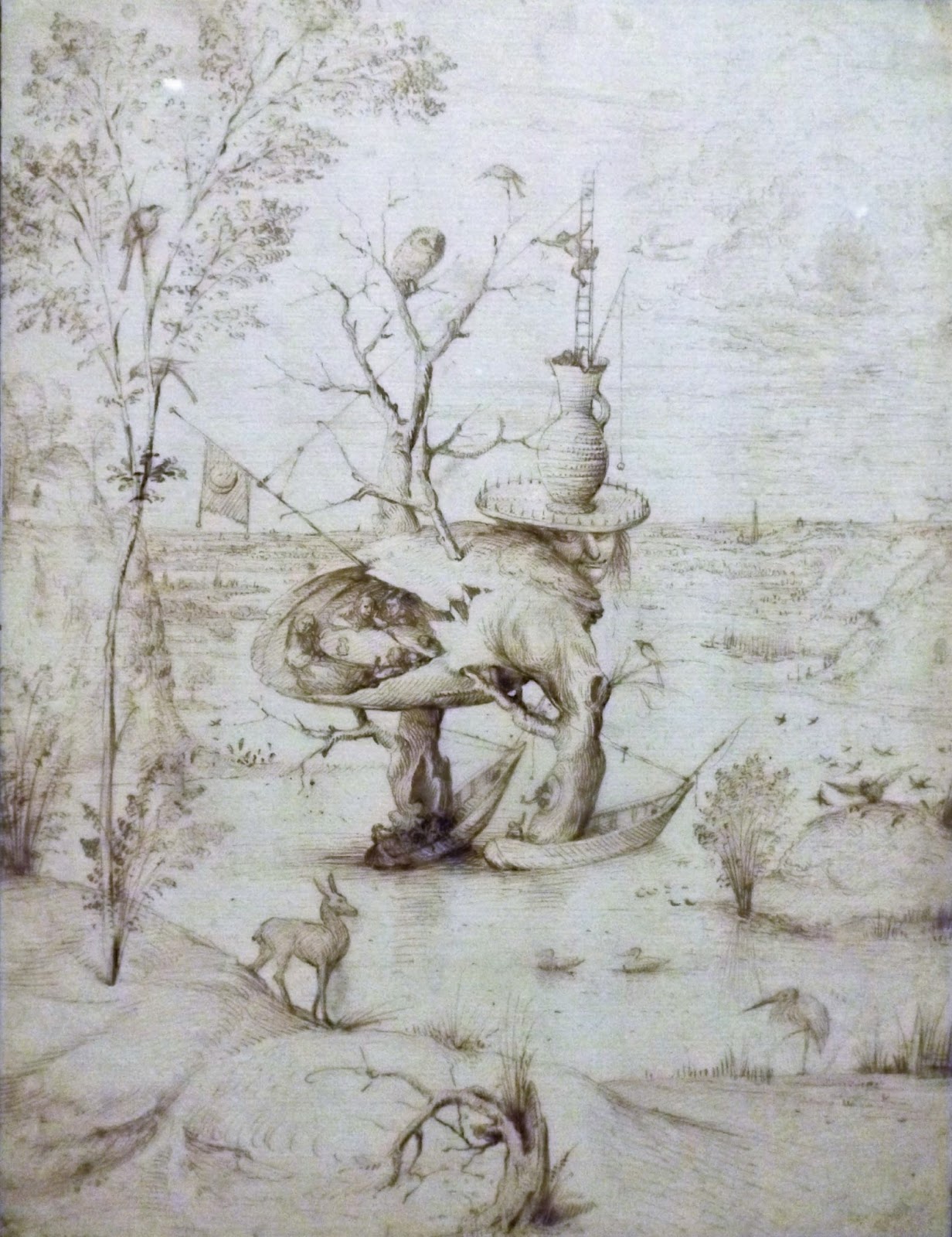
 Many people at the time thought that Bruegel outdid Bosch.  Can anyone argue against this?
 
 One of Bosch's most famous drawings was also on display in the exhibit.
 
The Artist and the Patron, one of the most powerful drawings on the subject, by Bruegel.

Even now, nearly one month later, my head is still pleasantly filled with images from Bruegel's art encountered in Vienna.  Had this been the sum of our experience there, then the trip would have been easily worth the expense and hassle of getting there.  But there was more.  Much more.
There were two other temporary exhibits at the Albertina on our visit.  One of them was entitled "Monet to Picasso," and the other one was "Raphael."  I was not in my right mind when I decided to do a quick walk-thru of the Monet exhibit instead of the Raphael.  I think I was mentally exhausted from the details in the Bruegel works, and wasn't ready to meet Raphael head-on.  Monet was easily digestible, on the other hand.  And we had paid another king's ransom to get into the museum, so we took a stroll into Monet.  The Albertina now owns a large collection of paintings, recently donated, and exhibits them in rotating shows.  There were Monets, there were Picassos, there were other Impressionists and Expressionists.  There were works by Klee, and a truly wonderful painting by Feininger, one of our favourite artists.  However, we walked unknowingly into a room of paintings by an Austrian 20th C. painter we had never heard of, and we would never be the same again.

Franz Sedlacek is one of the most amazing discoveries we have ever made, equal to the time we discovered a private collection of superb works by Dali in Cleveland, Ohio, many years ago.  Though well-known and loved in Austria, he is virtually unknown outside the country.  We gaped in disbelief at about ten of his paintings on display, not knowing if we were dreaming or actually seeing these things.  Later in the week we tracked down an exhibition catalogue of his art, purchased it, and it is now one of our most prized books!  Prepare yourself!

One of the really neat things about Sedlacek is that he was heavily influenced by early Flemish painting, including Bruegel.  This aspect tied in so well with our visit.

Winter Scene, Sedlacek

 The simply mind-blowing Twilight Song.  Let it be known that I would kill to own this painting.

 Landscape With Automobile, 1931.

We had a pretty fine time of it observing art in Vienna, without ever even getting to Klimt and his ilk.  Next time for sure.  One of the major painting museums was closed for renovations until November, so we will try to visit the Akadamie der Bildenden next time.  And to see more fantastic art by Sedlacek, put his name into Google Images, and enjoy the brain explosions.
 
Mapman Mike